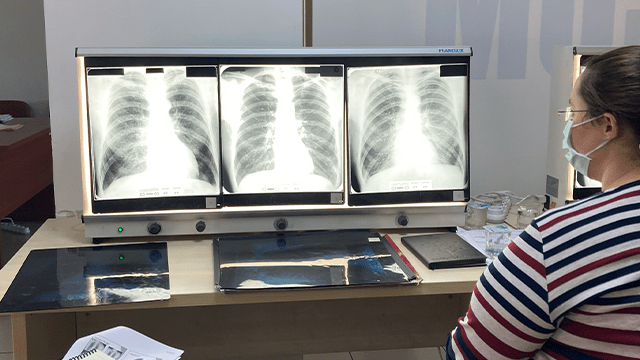
A physician evaluating chest radiographs during the International Labour Organization (ILO) Certification Program for the classification of occupational lung diseases. Photo by Zeynel Gül.
Drawing on an ethnographic study of occupational health litigation in Turkey, this talk examines how bureaucratic standards of evidence shape litigant workers’ moral and social existence. In Turkey, among roughly 12,000 workers who visit occupational hospitals annually for care and compensation for occupational diseases, only a small fraction is granted what they need. To receive care and compensation, workers must shuttle back and forth between several sites, including workplaces, occupational hospitals, bureaucratic offices, and courts. In the process, the fluid and unstable category of occupational diseases must be translated into legal documents in accordance with a logic of injury. The talk focuses on how the movement of diseases across the domains of the industrial, medical, and legal incurs additional forms of injury. I deploy the notion of paper injuries to capture the experiences of unemployment, mobbing, self-devaluation, harassment, and accusations of malingering caused by the unpredictable nature of occupational disease documents.
Zeynel Gül is an Assistant Professor of Anthropology at the University of Illinois, Chicago. He earned his PhD in cultural anthropology from Johns Hopkins University, specialising in medical anthropology, anthropology of law, and science and technology studies. His book manuscript, The Obsolete Clinic: Diagnostic Time, Documents, and the Right to Worker Health in Turkey, examines patients’ experiences with silicosis, a lung condition caused by inhalation of dust particles at workplaces. The Obsolete Clinic analyses how state-led expansions of medical care reshape health litigation and generate medical and legal uncertainty. His research explores how law and governance are embedded in the production of medical knowledge, contributing to debates on disease ontology and patient experience. He has published in American Ethnologist, Medical Anthropology Quarterly, Science, Technology and Human Values, SSRC Items, and the Journal of Occupational Health and Safety (forthcoming). In 2020, he joined a multi-country research team studying the effects of COVID-19 on working-class households.
This seminar will be held ONLINE only - Zoom link: https://anu.zoom.us/j/82431454032?pwd=owA39nWqTYm2TGOcC0sWa9bEDVangD.1
Location
Speakers
- Zeynel Gül (University of Illinois)
Contact
- Kirsty Wissing